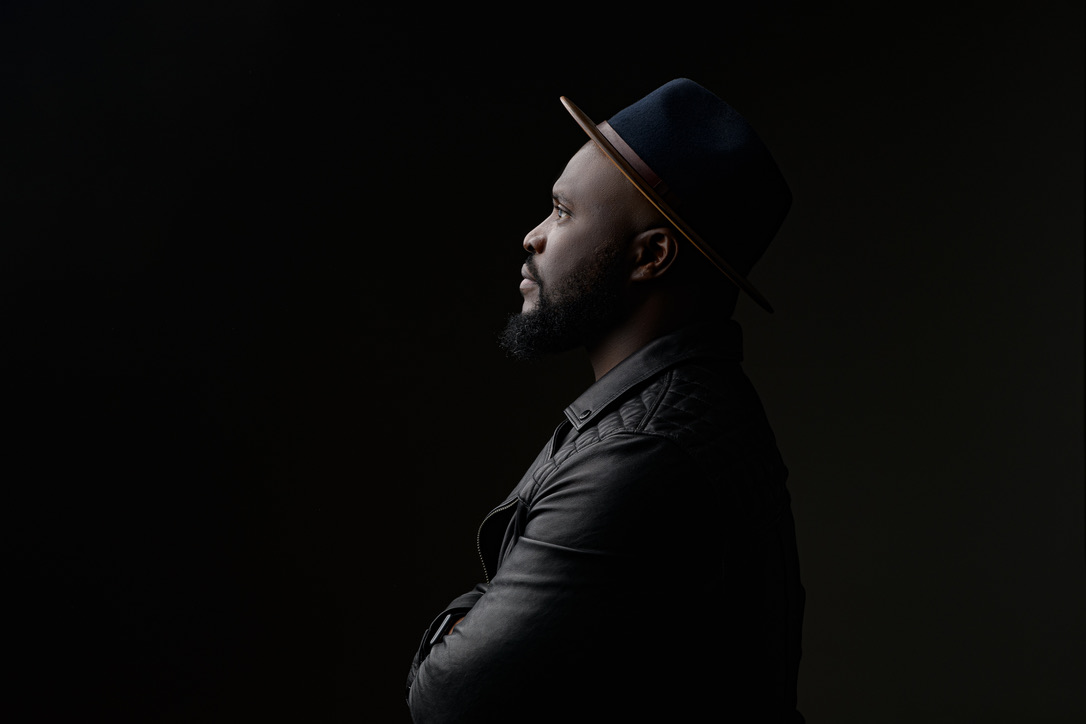
My grandfather, Odigie Iyamu, was a village chief in Ewossa, in Edo State. It is where my whole family comes from. He also hunted. My grandmother took whatever the family produced to market: yam, cassava, game he brought back, rubber. Between them they paid for my father's schooling. Neither of them learned English. They never needed to.
A teacher spotted that my father was unusually bright and went to my grandparents to argue that he should be sent on to secondary school. To pay for it, he got up at four in the morning to tap rubber before walking to class, producing stock for his mother to sell. He did well enough in his exams to win a place and a scholarship at university in Benin City, reading petroleum engineering. Benin City is a thirty-minute drive from the village now. At the time it may as well have been another country, and leaving felt like leaving the family behind.
He did his homework at night by the light of a lantern. So did my mother, and so did some of their brothers, sisters and closest friends. All of them made it. When I picture a child in a village studying by a flame tonight, I am not imagining anyone. I am picturing my parents.
He joined Shell, working between Delta State and Port Harcourt. He bought his first car. My mother taught nursery school in a small town beside the village, which is where I was born. We moved between those towns for years. Then Shell transferred him to Aberdeen, and that is how we ended up in Scotland.
What it cost him was never discussed. The only thing he ever said, years later, was that being that far away had been difficult. This was the late eighties. Communication was letters that took a very long time to reach a village in Nigeria and longer to come back, and phone calls meant travelling to a township to make one.
He never really left, though. In December 2025 my father was appointed a High Chief of Ewossa, following in his own father's footsteps. And the first Village Lantern, the free learning centre I am building, is going up there now, on our family's land.
“My grandfather ran a village. My father left it at four in the morning to tap rubber. I got a computer at four years old.”
Education in our house was not a value anyone talked about. It was a daily mechanism. My mother taught us at home after the school day, every day. School happened, and then school happened again. In Nigeria lesson teachers came to the house afterwards, and there was summer school on top of that. Britannica encyclopedias in Scotland, Britannica encyclopedias in Nigeria, and my father had the Shell library on top.
Every summer I came home from boarding school he handed me a list of topics: pick some, research them in the encyclopedias and the Shell library, and write me a report, typed. The Second World War. Napoleon. DNA. Einstein. Electricity and magnetism. Then he marked them and redlined them in red pen, spelling, errors, corrections. In the nineties. To a schoolboy.
The first computer arrived in Scotland when I was four: a DOS machine, black screen, no graphical interface. I learned to turn it on and type the commands to launch games. Minesweeper, Paint, and an old one called Cartoons, played with my brother. That is genuinely where the engineering starts.
At four my brother and I sat a nursery placement assessment in Scotland and scored far enough ahead, on maths and counting especially, that the school questioned how it was possible. They put me in a lower grade than the score warranted because the right one would have made me far too young, and I was still the youngest in the class. On the first day the head teacher called my mother in to a room she had filled with people from the school district, who wanted to know how. My mother, baffled, told them she taught us at home. I don't remember any of this; it's her account. The same thing happened again when we moved back to Nigeria.
I came back to Nigeria at seven with a thick Scottish accent. Nobody at school could understand a word I said, and I could barely understand them. I was mortified. That is the most foreign I have ever felt in a room, and it was in my own country.
Before I could talk I took apart every toy I was given. Not to break it. I wanted to see it. I'd pull the wheels off a car to look underneath, then try to put it back together and cry when it wouldn't go back the way it was. My parents still complain about this.
At seven or eight I built a working remote-control car by scavenging the motor out of another toy and building a shell around it to drive the wheels. I opened the VCR, the cassette player and the radio to find out how they worked. I wired the radio antenna to a metal mosquito net because the signal got better; it was years before I understood that I had extended the antenna and made it directional.
We made most of what we played with, bows and arrows, a sword chipped out of wood, a football made of tape, games built from sticks and wire. The most ambitious was the paraglider my brother Nosey and I built in the yard out of palm fronds, palm leaves, wood and a tarp, working from the specifications in a book called How Things Work. It did not fly. I don't know what we were thinking, but at least we built it.
I wanted to be an astronaut, then a neurosurgeon in my early teens because I was fascinated by how the brain works, then, after a careers session at school, mechatronics, robotics and nanotechnology, because I was interested in brains and robots at the same time. That resolved into AI, which is what I went to university for. I still have the statement of purpose I wrote for grad school. It says I have always wanted to work in AI.
I was walking through the university centre on my way to the lab in my first year of grad school when I ran into a friend from undergrad who was now at Microsoft, standing at a careers fair. He offered to put me forward. I went to the lab, printed my résumé, came back and handed it over, certain nothing would come of it. The interview was for a developer role, and afterwards the interviewer asked whether I had ever considered product management, because I cared about why things were built, not just what. He warned me it was harder to get.
The next round was on-site in Seattle, for the PM role. They put us up at a hotel in Bellevue, all the candidates together, and the others were from Yale and Harvard. I remember thinking: I do not belong here, I have no business being here, I don't even know why they called me. At dinner the night before, everyone practised the questions they expected, how would you count the golf balls in a bus, and I could not answer a single one. So I decided I would work it out on the spot, and I prayed.
None of those questions came. What came was real product work: design a video thumbnail picker. Then another interviewer asked me to design an app for capturing your thoughts, which fifteen years later is Strata. On the bus back the other candidates compared answers, and I found myself critiquing theirs. Twenty-four hours from unable to answer one question to marking everyone else's.
Office Web Apps taught me two things the hard way. My manager asked for a spec on my first project and I wrote everything. The database architecture, the state machines, all the engineering, and was told I had gone way too far, that I was a PM now. Toning that instinct down was genuinely difficult, and I coach other engineers through the same transition today. The second lesson: nobody lets you make radical changes to the thing paying the bills. Office was earning tens of billions a year, so the work was small features. You're really just maintaining things.
I left as Ballmer was going, Satya was arriving, Nokia had just added tens of thousands of people and a similar number were being cut. Everyone was on edge and my friends were working on genuinely interesting things. I wanted the next big thing, and Office wasn't it.
“I do not belong here. I have no business being here. Twenty-four hours later I was marking everyone else's answers.”
TinyOS was a federated computing company. A decentralised operating system running across devices large and small, sharing resources between them, so a device short on memory could draw on one that had it. Nobody would invest in that. It is a reasonably ordinary idea now.
Drones were where the money was, and some of the TinyOS research carried straight over, so it was a pivot of the idea rather than a clean break. D-Watch became an autonomous drone surveillance system: you plot an area on a map and a swarm goes and surveys it. My grad research was in computer vision, so the two halves fit.
The best vision model available then was Yann LeCun's convolutional neural net. I deconstructed it so it ran across three tiers. The drone, the hub and the cloud, as though it were one system, at low latency, with staged outputs at each tier at increasing confidence. That was 2015.
The other decision I would still defend: one of the biggest regulatory pressures on camera drones in the US and the EU was privacy, and rather than wait for the rules we designed the prediction system to be privacy-conscious from the start. That is the decision that later got me hired by Google.
Then regulation arrived and restricted how high drones could fly and what they could be used for, and it killed almost every drone company in the US. It killed ours. It felt horrible. It felt like I was just doing everything wrong, and nobody really cared about the innovation we believed we had produced.
A recruiter reached out because my D-Watch privacy work had been flagged by the security and privacy team, Google was building out its privacy org and wanted people with a genuine privacy instinct who could also engineer. I had applied once before, in my third year of undergrad, and been turned down. This was the second attempt and I intended to get it. I have never studied for an interview the way I studied for that one: two books, cover to cover, twice, every exercise done. By then I had run out of money, broke like a dog, with a mortgage and car notes, so it landed exactly on time.
With one other person, I co-launched Google's ML privacy org as a Senior TPM. It grew to thirteen people and covered search, several research teams, later the assistant teams, and Google Health. Then the person running payments privacy left and I inherited that org too: eight more people, two orgs at once.
The thing I would still point to is the review process. Until then, any product using AI went through its own general launch review, which meant the AI-specific questions mostly got skipped. I designed a single ML privacy review that every AI launch at Google passes through, and I made one decision that mattered more than the rest: it gates on access to user data for training, not just on launching something to users. That pulled the whole of Brain, the wider AI research org and DeepMind under the same standard as Search, Assistant, Photos, YouTube and payments risk. It added friction to other people's launch paths, so it needed VP-level approval across a lot of orgs, and it took a real fight. It is still in use. Some of that work went into Google's AI privacy principles, one name among many.
The Android Pay to Google Pay rebrand happened on my watch. By the end of 2018 it was live in twenty-eight countries.
Then I moved to the Brain team as a Senior Product Manager, leading several initiatives. The public one is Magenta: VAEs, RNNs and GANs generating beats and rhythms, and doing style transfer. Research PM work is measured by what transfers, not what launches; the one thing that shipped to the outside world was an Ableton plugin.
I had set myself a trip-wire years earlier: if I ever caught myself thinking more about the thing I was building on the side than about my work here, that was the signal to go and do it full time. Early in 2021 that happened. I still love Google. I would go back.
“If it got to the point where I was thinking more about that than my work at Google, that was the signal to leave.”
ace.fan let artists leverage their fanbase, launching tokens fans could buy and trade, generating a return on those transactions and funding things like studio time. The hardest year was the last one, by a distance.
We were raising a Series A at the end of 2022 with commitments from funds and ventures, and we were close to closing. Then FTX collapsed. Every commitment went to zero. Everyone pulled out, not because anything was wrong with the product, but because of how the entire crypto space suddenly looked.
What followed was four months, not one bad day. We laid people off in stages, deliberately, to stretch the runway in case it could still be saved, and stayed optimistic while the market kept getting worse. I put a great deal of my own money in trying to keep it alive and find an investor still liquid enough to come in. And underneath all of it is the trap: if you look desperate, it is very hard to raise. Eventually we let everyone go and it was just the founders.
Two lessons, and they are not the tidy ones. Don't put that much of your own money in. That was the real mistake. And freeze sooner: we should have paused the company cleanly and kept the optionality instead of prolonging it. The company isn't dead, which rather proves the point.
We moved to Dubai at the start of 2025 wanting a change. Better healthcare, better quality of life, and the honest reason underneath it: we are starting a family and going through IVF, which runs to twenty-odd thousand dollars a round in the US and costs substantially less here. We have worked hard for a lot of years and still felt like we were burning the candle at both ends. We looked at Singapore, London and New York too. We were set on London until we started looking at houses, found we would be giving up too much for the money, and realised it would be more of the same as the Bay Area anyway.
Dubai AI Week happened entirely by chance. My wife had joined Creators HQ and met someone there who was looking for delegates for the Nigerian delegation, put my name forward, and once we'd talked we were both invited to Dubai AI Week 2025 as part of the Nigerian delegation. What I speak about is the same thing I always speak about: the world counts Africa out. I won't pretend there is a strong AI core on the continent yet, because there isn't. But Africa has the youngest population in the world, a median age of around nineteen, and those are people who already know about AI and will use it heavily. What I want is more Africans building African AI solutions, grown from talent inside the continent, not localised copies of someone else's.
People ask whether there's a thesis behind Tessera, Hiveclaw, Pericls, Panio, Strata and Geoffrey. Honestly: I love solving problems and I love building, and I have an unfair edge because I've worked in this space and designed these models, so I know which buttons to press. When an idea arrives I just want to build it. They solve different problems for different people, but mostly they're solving problems for me.
The exception is Village Lantern: free learning centres that arrive on a truck, power themselves, share their Wi-Fi and the power they don't use with the village, and keep teaching when the satellite is down, because the tutor runs on the Lantern itself. I am building the learning platform myself. The first Lantern is under construction in Ewossa, and I am making it a proper non-profit so it outlasts me. That one isn't solving a problem for me. It is for the children who are as bright as my father was and haven't yet had a teacher go and argue their case.
The last time I wrote production code was today, debugging Strata, Geoffrey and Pericls, with Hiveclaw next.
“Continuing to work on tough problems, solving things that have the potential of changing people's lives in a meaningful way.”
I speak about the same thing wherever I am asked: building AI where people say it cannot be built, and counting Africa in.
Member of the Nigerian delegation; the future of AI across Africa
“DeFi For Good”, on what ACE was trying to do for artists
Guest speaker
“ACE, an NFT-based funding platform, is giving talent their power back”
The next chapter is being written from a laptop, usually late, usually with a swarm of agents. Come see what I'm building.