Village Lantern.
My grandparents paid for my father's schooling by selling yam and hunted game at market in Ewossa. The first Lantern is going up there, on our family's land. This is not charity. It is talent infrastructure, and it is how you get Africans building African AI instead of localising someone else's.
1of 1,000
Twenty-five Lanterns by 2030 is the plan. A thousand by 2050, and a million children learning in them, is the goal.
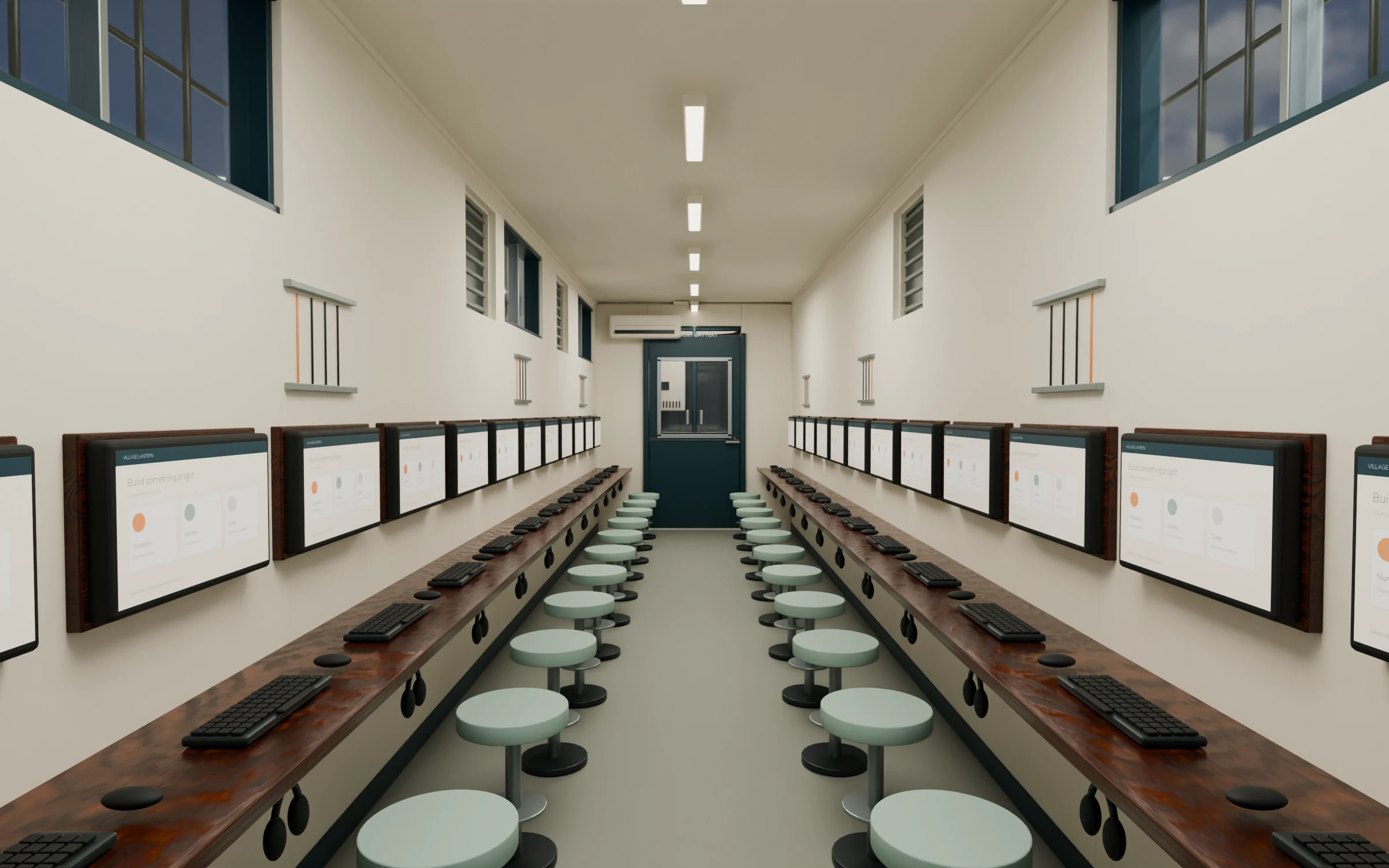
Visit villagelantern.orgA free place to learn that arrives on a truck. A site-office container, the kind a crane drops onto a construction site, made into a classroom: twenty-four learning stations along its walls, and a second container stacked above it where a facilitator lives. Put four stilts in the ground, lower it on, open the doors, connect it, and it is live. Each one is a Lantern.
Solar panels on the roof and a solar canopy beside the classroom charge its batteries and run it day and evening. Whatever it doesn't use goes free through one cable to a public building nearby, a clinic first, never to private homes. Satellite internet on the roof, shared with the village as free, filtered Wi-Fi. When the dish goes down it keeps teaching, because the tutor runs on a small model on the Lantern's own computers. It only knows the lesson in front of the child, and it never gives the answer. The children get drinking water that is filtered and tested, handwashing taps, and toilets of their own: one for girls, one for boys and an accessible one.
Every child moves at their own pace: learn, get tested, get told what to work on, go back until they have it. Version one teaches Maths, English and Coding to ages ten to fifteen. Mastery earns tokens, and tokens buy time online or time to play. Every repeat earns less than the last, so cramming doesn't pay and spaced review does. The ambition is the best teachers in the world building courses for these children, for free.
Underneath it there is a talent layer. Each child's record shows how they are doing, objective by objective, so we can find the brilliant ones, go and get them, and put scholarships in front of them. That is the actual point. I don't want to localise someone else's AI for Africa. I want Africans building African solutions, and that has to start with finding the talent.
The first Lantern is going up in Ewossa, on our family's land. The next four are planned for Nigeria, Ghana, Kenya and Rwanda, and none is built until it is fully funded. Where a Lantern's seats fill and children are waiting nearby, it can grow into a campus. Twenty-five Lanterns by 2030 is the plan. A thousand by 2050, and a million children learning in them, is the goal. Full 501(c)(3) non-profit status is in progress. It takes time, and I would rather it take time and be done properly.

While I was at Google I mentored high school students through iMentor. Schools where almost nobody goes on to college. The job was mostly to be standing proof that it can be done, and to explain what school is even for. These days I mentor and teach some of the coursework at Founders Institute, and I work with the founders in my angel portfolio. The rest arrives through LinkedIn and referrals. Mostly Black and minority founders, either first-timers or people who need the technical half.
It is hard as a minority founder to get good help or good advice, particularly from someone who looks like you and therefore understands the specific thing you are up against. So the policy is an open door. If you reach out I will at least try to help, or point you at someone who can.
What first-time founders get wrong about fundraising, in order. They don't understand the economics of the people they are pitching, a VC is a business deploying its LPs' money and has to beat the public markets by a distance, so you need to know a firm's principles and what kind of deal actually works for them. They are often working on the wrong idea, and wrong has a specific meaning: there are tons of great ideas, but a great idea is not necessarily a great business in your hands, at this time. Timing matters, and so does whether you are the right team for that problem, institutional investors see that immediately. And most skip customer discovery entirely: is this a painkiller or a vitamin, is it a real problem they still wouldn't pay to fix, would they actually pay, and is the person with the problem even the one who holds the budget?
I am not investing at the moment, and I have done a fair amount of work to slow the inbound, so this is not the page to pitch on. What I can still offer is the judgement.
I have raised into a crypto winter and watched every commitment evaporate in a week. I have shipped at Microsoft and Google scale. I have had to let everyone go. Within one conversation I can usually tell you whether you are the right team for that idea at this time, which is a more useful thing to hear early than a cheque you were never going to get.
Don't ask for a check. Ask a hard question.
I'm not writing checks at the moment. Village Lantern is funded by people who decide to fund it. A gift can help finish Lantern 1 or light one of the next four. Light one and give it a name, keep one lit month after month, teach a course, or build a game for the kids to play.